

Your shipping package has reached Australia. The customs clearance is finished, and the required duties and GST are dealt with. It may seem that the shipment is available for release.
However, a question arises:
Has the cargo been cleared by the biosecurity authorities? This is where many inexperienced importers fail to understand the way the Australian import system works.
Customs clearance and biosecurity clearance are two different processes. They involve different regulations and serve to eliminate different threats. Your shipment may fulfill customs requirements and still be subject to biosecurity rules such as documents’ inspection, cargo assessment, treatment or quarantine.
With food shipments intended for sale, there can be additional safety requirements that need to be fulfilled after the cargo is cleared by biosecurity authorities.
Being aware of the key differences between customs clearance and biosecurity clearance can help new importers avoid some delays, mistakes in documents and risks of failure at their business operations.
In this blog, Sharp Blue clarifies the distinction between customs clearance and biosecurity clearance, describes what takes place when cargo is detained for inspection or treatment, and indicates the checks that importers should conduct prior to transportation.
Customs Clearance vs Biosecurity Clearance: What Is the Difference?
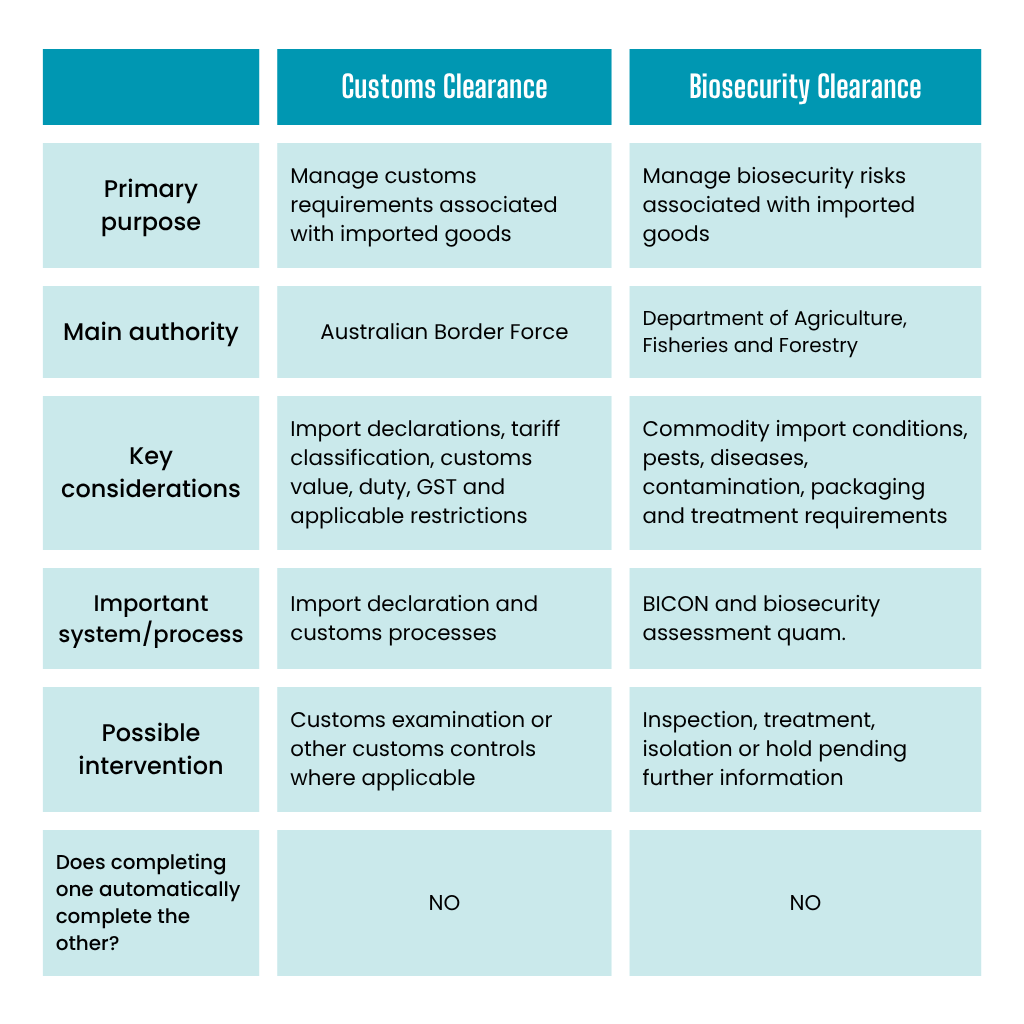
Basically the main difference can be summarized in this way:
Customs focuses on the customs regulations and border control issues in Australia regarding imported goods.
Biosecurity is about keeping Australia safe from pests, diseases and other biosecurity threats associated with shipping goods, cargo, packaging or containers.
The two processes complement each other but do not replace each other.
Detailed requirements depend on goods, their origin, route and circumstances.
What Does Customs Clearance Actually Cover?
When products come into Australia, importers have to fulfill the required customs obligations. Customs controls in Australia are under the supervision of the Australian Border Force. Processes that take place during imports can include information such as goods description, tariff classification, and customs value. There may also be duties and GST applied based on the goods and any exemptions related. (Australian Border Force)
For instance, an importer must find the right tariff classification and submit an import declaration with proper information.
This is important because customs treatment will have an impact on the amount of duties and taxes to be paid, and whether or not there are other customs limitations and regulations.
However, customs clearance is not the full process and does not mean that all biosecurity procedures are already completed.
What Does Biosecurity Clearance Mean?
Australia has implemented strict biosecurity measures in order to prevent the risk of exotic pests, diseases, and weeds from being introduced into the country through the import of goods.
The Department of Agriculture, Fisheries and Forestry (DAFF) has been put in charge of overseeing Australia’s biosecurity import requirements.
The specifics surrounding these requirements may differ to a great extent based on what is being imported.
For example, these requirements may apply to:
- products from agriculture and plants;
- products from animals;
- food items;
- soil or products contaminated by soil;
- packaging made from timber and dunnage;
- containers; and
- other items that could pose a biosecurity risk.
DAFF’s Biosecurity Import Conditions System (BICON) is the platform on which the importers will determine if specific items may be imported under specific requirements. Depending on what the goods are, BICON will outline what kinds of documents, treatments, or permits must be obtained prior to importation.
Why Customs Clearance Does Not Automatically Mean Biosecurity Clearance
Let’s consider a basic example. An importer in Australia imports a cargo container filled with pre-packed goods into Sydney. The immigrant gives the necessary information for customs clearance in the process of customs clearance. But then again, DAFF would want to make sure that the import is in compliance with its biosecurity regulations.
Thus the cargo can be in a situation when its customs clearance requirements have already been met but biosecurity requirements are still unmet. While DAFF claims that the import will be released from the board of biosecurity restrictions via the information and declarations submitted by the immigrant, it also allows for a possibility of situation when DAFF may demand for inspections, treatment, isolation or even holding of cargo assuming that some inspections are still necessary.
According to DAFF guidelines on biosecurity control of cargo containers, it is required for all cargoes to undergo biosecurity inspections before cargo container can be released from biosecurity control.
What Happens When Customs Is Cleared but Biosecurity Isn’t?
Once customs clearance is completed but biosecurity clearance is yet to be resolved, the delivery process may need to wait.
Next steps depend on the biosecurity reason for which the cargo is being held.
A DAFF officer may request:
More documentation → Inspection → Treatment→ Isolation → More information → Release
Not all cargo needs to go through those steps.
In reality, DAFF employs a risk-based management policy for imported goods, and many consignment clearances are obtained through documentation and declarations. However, cargo can be singled out for inspection or other interventions, if necessary.
For importers, this could mean the necessity to change the delivery schedule.
The delay may cause changes in logistics, such as transportation, warehousing, and containers’ free time arrangements. In specific situations, additional freight charges, detention, or time in storage may occur.
But these costs are not automatic, which is why importers should check for biosecurity obligations prior to the arrival of the shipment.
When Is a Biosecurity Inspection Required?
Not all the containers that cross a border undergo an equivalent kind of physical examination.
DAFF implements a risk-driven strategy and concentrates the inspection of activities on items and channels that carry a significant biodanger. Certain programs that are considered risky are subjected to additional control measures. (DAFF — Arrival of goods in Australia)
For example, DAFF treats certain places and channels accordingly, thus being guided by its Country Action List (CAL) and enhancing the control over the cargo concerning biosecurity.
Inspections can be carried out at a port of entry or a recognized third-party facility. (DAFF — Clearance and inspection of goods)
The inspectors can analyze the packages, container, and the goods for the possible presence of biohazard materials.
Potential results include:
Release of goods from biosecurity regulations
or
Release from biosecurity regulations and the need in some remedial actions, that include the movement of goods to the site of an Approved Arrangement or if isolation or some additional information is needed.
What If the Documents Don’t Match the Cargo?
Proper documentation is probably the simplest method of avoiding unnecessary complications for importers.
The information given to authorities must reflect accurately the shipment and satisfy the requirements for that commodity.
Issues can occur when:
- the description of goods does not match reality;
- necessary documents are lacking;
- proof of treatment is not provided;
- information about packing is incorrect;
- timber packing or dunnage is not properly documented; or
- the cargo does not comply with the requirements mentioned in BICON.
DAFF emphasizes in its publications that if all the required documents listed in BICON have been received, it will be less likely for goods to require inspection before sale. (DAFF — Clearance and inspection of goods)
DAFF also states that containers FCL/FCX carrying goods that lack documentation in BICON can be redirected to a Class 1.1 Approved Arrangement site. (DAFF — Cargo containers)
The lesson is simple:
Documentation should be verified before the container is sent from ports, not after it arrives in Australia.
What Happens If Treatment Is Required?
There are some products which need biosecurity importing conditions meaning they should undergo special treatment before or right after reaching Australia.
The requirements are determined by the type of goods in question as well as the specific BICON case.
Sometimes treatments can be conducted outside Australia namely using the services of the approved provider. Sometimes the treatment needs to be done only after the products appeared in Australia. (DAFF – Treating cargo outside Australia)
Treating products isn’t a matter of finding an additional fumigation company or a provider of the treatment.
Treatments should comply with Australian requirements.
Contaminated containers and cargo found when importing need to be treated before their release. (DAFF – Cargo containers)
This makes it clear that it is critical to check BICON prior to shipping.
In case the shipments undergo the treatment beforehand they pose less danger of the need for an extra intervention in the country of destination.
What About Food Imports?
Food imports create a multitude of challenges.
A food importer needs to comply with biosecurity protocols, health standards, and Australian food laws.
Current guidelines from DAFF highlight that:
Biosecurity requirements must have been met before Insightful Food Inspection Scheme (IFIS) requirements come into consideration.
This means that food importation involves both biosecurity and food safety compliance processes. (DAFF — Process of importing food to Australia).This is crucial for companies that import food products, including meat, fish, dairy, grain, processed food, and other products.
What Is the Imported Food Inspection Scheme?
The IFIS (Imported Food Inspection Scheme) refers to Australia’s imported food inspection system characterized by risk-based principles.
If DAFF refers any importation of food to IFIS, it means that such food will be examined for conformity with the food standards of Australia and safety requirements.
Once the applicable biosecurity measures have been satisfied, particular food items shall be directed to IFIS for inspection and testing. (DAFF — BICON)
Just because food is referred does not mean that it’s failed.
It means food selected for the appropriate inspection or testing procedure.
As soon as the food is referred, the adequate regulations have to be observed while inspection or testing is carried out. The results will depend on the outcome of the inspection or testing carried out.
BICON: The Check You Should Make Before Shipping
For Australian importers, one of the key items to check before shipment is BICON.
Importers should figure out what rules and regulations are in place for their goods before they confirm transportation.
With BICON, one will be able to find out whether the goods:
- are allowed into Australia,
- fall under biosecurity regulations,
- need supporting documents,
- need to be treated, or
- require an import biosecurity permit.
In the case of food, BICON also offers useful information related to food safety, as well as inspection and testing requirements. (DAFF – BICON).
This means that the process should basically look like this:
Identify product → Check BICON → Make sure the requirements are met → Prepare documents → Confirm compliance of suppliers → Ship.
Instead of:
Ship → Wait → Check for issues.
DAFF advises to make the product and packaging comply with Australian regulations before the shipment takes place. (DAFF – Preparing for import).
Customs and Biosecurity: Why Coordination Matters
Though customs and biosecurity are handled as separate regulatory processes by importers, the two are an integral part of the same shipment process.
Let’s look at the shipment journey:
- Supplier
- Documentation and compliance check
- Freight booking
- Export
- Arrival in Australia
- Customs requirements
- Biosecurity requirements
- Inspection or treatment
- Release
- Inland transport
- Warehousing.
Any glitch at one stage will affect the next in the process. For instance, incorrect documentation at one point will create a chain of queries, biosecurity inspections will affect the delivery schedule, treatments may require moving goods to an Approved Arrangement site, etc.
It must, therefore, be understood that freight forwarding is not simply about transporting goods from one port to another; it also entails coordination of documents, information, transport and other aspects of the shipment with many parties involved.
A Practical Pre-Shipment Checklist for Australian Importers
Do not forget to check the following:
- Product: Is the product description correct?
- Classification: Has the tariff classification been determined?
- Origin: Has the country of origin been documented accurately?
- BICON: Have you verified the biosecurity order that applies?
- Permits: Do you require a biosecurity permit?
- Treatment: Does the product or the packaging require treatment?
- Packaging: Is the wooden packaging compliant with Australian law?
- Documents: Are the required paperwork, declarations and certificates in order?
- Food: Have you checked food safety requirements?
- Freight: Have you arranged customs clearance, biosecurity checks and the freight?
These things must be checked before shipment when there still is time to rectify a problem in case there is one.
The Bottom Line: Customs Clearance Is Not Biosecurity Clearance
For importers in Australia, the differentiation can be simply stated as follows:
Customs clearance is the process of dealing with Australia’s custom formalities concerning imported items. This includes the relevant declarations, classifications, duties and taxes.
Biosecurity clearance refers to Australia’s issues with imported items that include pest and disease management.
Food safety compliance involves the procedures determined by the suitable food regulations in the case of food products that must be duly followed.
Although there are relevant connections between the two processes, they are not interchangeable.
Customs clearance operations may necessitate some other biosecurity actions (before the cargo could be delivered).
The best prevention method is knowing the requirements beforehand, preparing documents appropriately and arranging the transport and clearance process in advance.
Sharp Blue provides leading services in the coordination of international shipments, custom clearance operations and the transporting process.