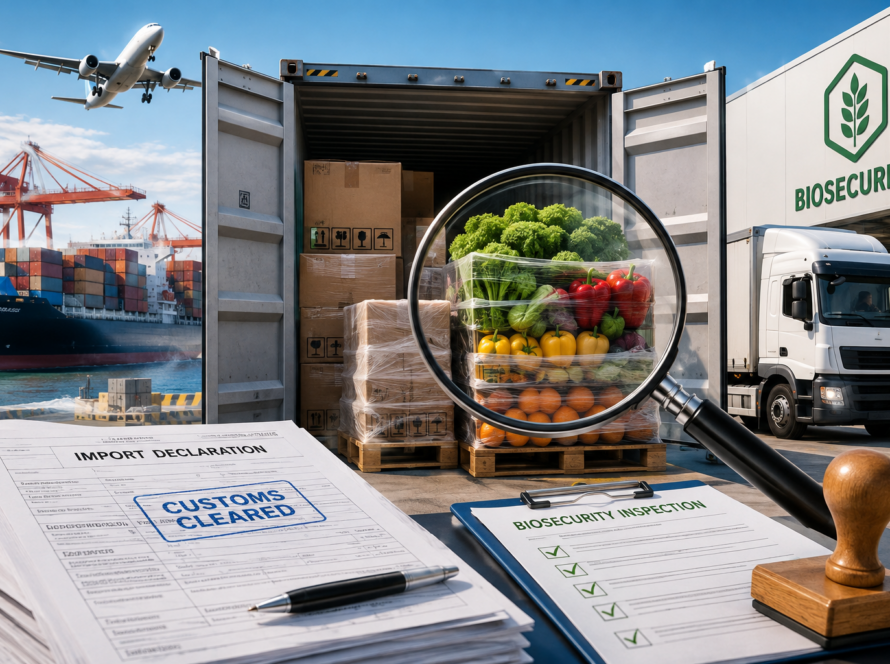


There is more to importing furniture into Australia than simply setting up for international shipping. Goods need to conform to the Australian importation rules and bio-security measures before they are released from custom controls. Everything that relates to importation from accurate documentation to timber treatment and quarantine guidelines will affect your ability to get your goods out of customs fast.
Failure to adhere to such importation regulations will result in inspection, delays, extra treatment, storage fees, detention and demurrage charges. Proper planning and adherence to these regulations will go a long way in minimizing these risks.
This blog by Sharp Blue will provide an overview of the processes associated with obtaining clearance from customs for imported furniture. The guide discusses how to prepare all necessary documentation, customs procedures, biosecurity procedures, and other practical steps to obtain compliant and efficient importation into Australia.
Understanding Furniture Import Clearance in Australia
For furniture to be allowed into the Australian market, it has to go through two distinct but equally important processes before entering the market.
In the first place, customs clearance is done through the Australian Border Force (ABF). Customs clearance is concerned with the verification of the correctness of the import declaration, the classification of the tariff, the amount of customs duty, the amount of Goods and Services Tax (GST), and whether the items conform to the regulations of importation in Australia.
In the second place, the Department of Agriculture, Fisheries and Forestry (DAFF) provides for biosecurity clearance. The function of biosecurity clearance is to ensure that there is no entry of any pest, disease, and/or contaminants into Australia through the cargo and its packaging.
Furniture brought into Australia usually undergoes closer inspection due to the potential use of all kinds of timbers, which may include bamboo, cane, rattan, wicker, or others, making the importation of such furniture products subject to higher biosecurity concerns. In addition, all the pallets, crates, or timber braces used in moving the furniture products would also be inspected, regardless of whether the final product is made up of processed timber products or not.
Preparing the Required Documentation
Long before an import shipment arrives in Australia, the clearances needed for that shipment must begin to be prepared. Collecting documents before the shipment arrives has two main benefits for importers. It gives them the opportunity to resolve any possible problems before their products are shipped to Australia and helps the customs and biosecurity Assessment process be completed more efficiently.
The key documents generally required for furniture imports include the Letter of Authority (LOA), Bill of Lading or Sea Waybill, Commercial Invoice, Packing List, Certificate of Origin (where applicable), Packing Declaration, and Fumigation or Heat Treatment Certificate when timber packaging materials have been treated.
All of the above documents must be reviewed very carefully against the other documents from the importer to ensure that the product description, quantities, invoice value, weight, consignee name, container id, shipping etc. all match on all of the documents. The Import Clearance process can be delayed if there are discrepancies between documents, as this will require Customs to contact the importer to clarify.
Customs Classification and Import Declaration
After the documents have been cleared, the next step is to ensure that the imported furniture has the appropriate classification using the Harmonized System (HS) Codes.
Furniture is normally categorized under Chapter 94 of the Harmonized System, and most of the wooden furniture falls under HS Code 9403.60. The classification depends on various things, including material used to make it, construction, and purpose.
The proper application of tariff classification is very important because it will determine the amount of customs duties and GST that will be paid on the goods.
With the confirmation of tariff classification, a declaration is made using the Integrated Cargo System of Australia. This declaration will include details like the name of the importer, name of the supplier, country of origin, customs value, tariff classification, and details of the shipment. Documentation may also be provided when necessary to help assess the cargo.
The process of biosecurity assessment of the cargo takes place when the declaration has been processed and all customs requirements are fulfilled.
Biosecurity Requirements and Timber Treatment
Australia has one of the toughest biosecurity laws in the world. They aim at preventing any possible introduction of insects, plants’ diseases, fungi, and other potentially harmful organisms into Australia’s unique environment and agricultural sector.
Since cargo ships usually carry wood or are transported in wooden packaging material, they are subjected to a lot of biosecurity screening. The cargo, timber pallets, wooden crates, dunnage, packing blocks, and any other wood-based packaging material are screened for compliance.
In case there is any timber packaging material which does not comply with the biosecurity laws, then the authorities will ask for inspection, fumigation, heat treatment, re-exportation, or even destroy the cargo before releasing it.
This is why, importer should know about the biosecurity rules before bringing your goods to Australia from the country of origin.
Understanding ISPM 15 Treatment Requirements
Most timber packages used in international transportation are supposed to adhere to the International Standards for Phytosanitary Measures No. 15 (ISPM 15). This international standard provides approved treatment methods aimed at minimizing risks associated with transporting pests in the wooden packaging material.
Two main approved treatment methods include:
Heat Treatment (HT): Heating the timber to a certain core temperature for a stipulated time period for killing insects and larvae.
Methyl Bromide Fumigation (MB): Treating the timber with methyl bromide gas for destroying pests prior to exportation.
Compliant packages are usually stamped with the official ISPM 15 mark indicating the country of treatment, the provider of treatment services and treatment methods applied.
While adherence to the ISPM 15 greatly minimizes biosecurity risks, there might still be some additional documents required by the authorities in Australia. It is advisable for importers to confirm the required requirements prior to export in order not to make any wrong assumptions regarding the package acceptance.
Why Packing Declarations and Fumigation Certificates Matter
The two certificates of utmost importance at the time of importing furniture are the Packing Declaration and the Fumigation or Heat Treatment Certificate.
The Packing Declaration shows the material used for packing during transportation and helps biosecurity officers determine if there is a need to conduct any other inspection or treatment.
In case the packaging of timber has been treated, the Fumigation or Heat Treatment Certificate serves as proof that the treatment has been done using internationally accepted standards.
But the presence of a certificate does not mean that the task ends here. In some cases, Australian biosecurity officials may verify if the treatment is done by an authorised entity whose identifier number is present in the Integrated Cargo System (ICS).
Should the certificate be difficult to verify, or fail to comply with the Australian requirements, the goods may then need to undergo inspection or treatment prior to final release. Verification of treatment certificates prior to shipment is therefore a key aspect in minimizing delays and avoiding extra expenses.
Common Challenges and How to Avoid Them
Despite adequate preparation, furniture may still face obstacles in passing the customs and biosecurity clearance. Most obstacles, however, are avoidable and can be dealt with more efficiently if detected in time.
The most frequent obstacle results from non-conformity of the fumigation or heat treatment certificate. The problem here arises when the cargo had already been fumigated or heated at the place of its origin; yet the certificate submitted does not comply with the established requirements, which means that the biosecurity authorities will not accept it for consideration.
In such cases, the furniture should be taken to the approved treatment center in Australia for fumigation or heat treatment, thus ensuring its legal entry into the country. Nevertheless, fumigation or heat treatment conducted on the territory of Australia is usually more costly than the same process conducted abroad.
Documentation problems can also lead to clearance problems. The problem may arise in the form of differences between the Commercial Invoice, Packing List, and Bill of Lading. For example, differences in quantities, description, invoice value, and consignee can cause problems.
Tariff classification errors can cause problems too. Wrong use of HS code may affect the customs duties payment and even attract penalties.
It shows the significance of document verification, review of the treatment requirement before export, and regular communication with suppliers and customs officials.
Avoiding Storage, Detention and Demurrage Charges
Biosecurity or customs holds can also add substantially to the cost of importing furniture because the containers can end up staying longer at the port than anticipated.
It is essential to know the distinction between storage, demurrage, and detention charges for proper planning of the shipment.
Storage charges arise where the cargo takes longer to be moved out of the terminal or warehouse past the free storage period.
Demurrage charges arise where there is an extra delay of the shipping container in the port or terminal outside the free time offered by the shipping line.
The detention charges arise where there is delay after the pickup of the container and its return to the designated container depot past the allowed free time.
This will mean that a lot of money will be added to the landed cost of importing products.
There are measures that importers need to take in order to reduce the risk of these charges including arranging for documents prior to the arrival of the ship, responding to biosecurity and customs requests, arranging transport, and knowing free time from the shipping line.
Final Customs Clearance and Delivery
Provided that the customs and bio-security checks have been completed, the cargo is available for collection from the port facility.
It will now be possible to arrange transportation for the furniture into the importer’s storage warehouse, shop, distribution center, construction site, or direct to the end-customer.
Proper delivery scheduling is vital to make sure that the containers are collected in time and offloaded within the free-time of the shipping line. Once the containers are offloaded, it is necessary to send them back to the designated depot without delay.
It is important to carry out these actions effectively to ensure that the whole import procedure is completed without additional expenses.
Best Practices for Successful Furniture Imports
The successful importation of furniture requires planning from before the shipment gets into the Australian shores. Adherence to some basic practices will help prevent any possible delays and costs.
First, make sure that your paperwork is complete, accurate, and consistent on all documents. Also, verify that the correct HS code has been entered and whether the consignment qualifies for any special preference tariff as per the Free Trade Agreement.
Where there is use of wooden packaging, you need to ensure that it meets the requirements of ISPM 15. You must also get the necessary fumigation and heat treatment certificate from accredited treatments provider.
During the course of importing, communicate freely with suppliers, freight forwarders, customs brokers, and government departments. Early communication will help you overcome any challenges without delays.
Lastly, arrange transportation and returns of empty containers before getting the goods into Australia to ensure prompt delivery and returns of containers within free time allowance period.
Conclusion
The import of furniture into Australia needs a lot of prior planning, documentation, and adherence to the relevant customs and biosecurity guidelines. Each and every step involved including document preparation, filing the Import Declaration, meeting timber treatment guidelines, among others, is key to facilitating a successful clearance process.
A number of the problems and extra costs associated with furniture importation can be minimized by being prepared beforehand. This includes checking of documentation, tariff classification, timber packing material adherence to ISPM 15 standards, and the confirmation of treatment certificates before exportation, among others.
Being proactive in collaborating with professional customs brokers, freight forwarders, suppliers, as well as other government agencies, goes a long way in ensuring potential problems are detected and sorted out beforehand.
Having good knowledge about Australian import regulations as well as best practices will facilitate efficient and cost-effective importation of the furniture shipments.
Frequently Asked Questions (FAQ)
1. Do all furniture shipments require fumigation before being imported into Australia?
No. It is not a mandatory condition that every furniture consignment be fumigated. Whether this is mandatory or not depends on what material is made of furniture, what kind of packaging is used, and what risk is assessed by the Australian biosecurity authorities. In case solid wood packing materials such as timber pallets, wooden crates, dunnage, etc. are used, they have to meet the ISPM 15 standards.
2. What happens if my fumigation certificate is not accepted by Australian authorities?
If the certificate presented is found not to comply with the biosecurity standards of Australia or if there is no way to validate the treatment from an accredited source, then the cargo will not be immediately cleared. In most instances, the cargo will be directed to undergo treatment in an accredited facility in Australia before being cleared. This will result in further quarantine costs, storage costs, transportation costs, and delivery delays, which make it much more economical to ensure that the certificate complies first before shipment.
3. Can furniture be inspected even if all import documents are correct?
Yes. Provision of full documentation does not ensure that a consignment is exempt from being inspected. Both the Australian Border Force and Department of Agriculture, Fisheries and Forestry could choose to inspect the goods on account of several factors such as the type of goods being imported, the packing materials, the country of origin, and others. Full documentation makes the process much easier, but does not prevent the inspection process from occurring.
4. What are the most common reasons furniture shipments are delayed during import clearance?
The primary reasons for delays in shipments are poor documentation or inadequate classification of goods, non-conformity of timber packing, no valid fumigation certificates, unsettled payments to customs, and bio-security inspections. Most of these problems can easily be avoided if all the paperwork related to the consignment is reviewed prior to the export of goods to Australia.
5. How can importers reduce the risk of storage, detention and demurrage charges?
The best way to go about it is to initiate the clearing process before the consignment arrives at the destination in Australia. Importers need to submit all their documents ahead of time, react swiftly to any queries raised by the customs or biosecurity authority, secure transport for their cargo before it is cleared, and return the empty container within the stipulated free time.